Monday, March 4, 2024

TaskVine at the HEP Analysis Grand Challenge

Barry Sly-Delgado and Ben Tovar recently presented our work on transforming high energy physics data analysis applications into near-interactive execution at the IRIS-HEP Analysis Grand Challenge Demo Day.

By using the TaskVine framework, we have enabled the transformation of a production physics data analysis application (DV3), reducing execution time from over an hour to just over three minutes 
on about four thousand cores of a campus HPC cluster.


Advancements to hardware and software components in an application stack aid in the facilitation of application reshaping. With application reshaping, we are transitioning applications from long running to near-interactive.  While improvements to hardware and low-level software improvements can produce measurable speedup, significant speedup is obtainable via optimization to the scheduling and execution layers of the distributed application.

TaskVine, our latest workflow technology, makes use of in-cluster bandwidth and disk to mitigate data movement by enabling peer transfers between worker nodes within a compute cluster.  TaskVine is currently used to run a variety of custom data analysis workflows written by the CMS physics group at Notre Dame.  These applications are written in high-level Python, making use of standard technologies like Numpy, Coffea, and Dask in order to generate large task graphs.  TaskVine then takes that graph and deploys it into the cluster.
 
Our previous versions of these physics applications utilized our earlier WorkQueue executor.  TaskVine improves upon the earlier system in two distinct ways:

First - While Work Queue only transfers data between the manager and workers, TaskVine transfers data directly between peer workers.  Peer transfers relieve pressure on the manager to distribute data dependencies to worker nodes within the cluster. For workflows that generate large amounts of intermediate data, this can be extremely costly to scheduling performance, because the manager sends and receives large amounts of data. 

This animation shows the data transfer throughout an application when using Work Queue:
While this animation shows the data transfers between all nodes of the cluster when using TaskVine: 
Second - TaskVine extends the notion of task execution into a serverless model.  Python code in the analysis application can be defined once as a LibraryTask which is deployed into the cluster.  Then, lightweight FunctionCall tasks can invoke the code in the LibraryTask without constantly restarting the Python environment.  In this modem the python interpreter is now invoked once per worker.

This graph compares the distribution of execution times between normal tasks and serverless function calls, improving the lower limit of execution time by an order of magnitude.

These four graphs show the overall performance of the data analysis application through four improvement states: first with Work Queue and Hadoop, then with Work Queue and VAST (new HPC filesystem), then TaskVine with peer transfers, and finally TaskVine with serverless execution.  Overall, this transforms a one hour workflow into a 3 minute workflow.


Tuesday, February 27, 2024

CCTools 7.8.0 released

We are pleased to announce the release of version 7.8.0 of the Cooperative Computing Tools from the University of Notre Dame, including TaskVine, Work Queue, Makeflow, Parrot, Chirp, and other software.

    Docs: https://cctools.readthedocs.io/
    Download: http://ccl.cse.nd.edu/software/download
    Forum: http://ccl.cse.nd.edu/community/forum

This is a feature release that primarily improves the scalability and performance of TaskVine:

Main Features:

    TaskVine dask serverless execution (i.e., function calls instead of tasks) to reduce overheads, by @BarrySlyDelgado
    TaskVine improvements to library and remove function calls dispatch, by @tphung3
    TaskVine temporary file replication, by @colinthomas-z80
    TaskVine automatic deletion of ancillary files (unlink_when_done) during workflow execution, by @btovar
    TaskVine use of memory buffers to serialize functions, by @btovar
    TaskVine cleanup of factory, worker information and stats, by @dthain
    Fix TaskVine memory leak in python bindings, by @JinZhou5042
    Improved Parsl integration with TaskVine and documentation, by @colinthomas-z80

 Full Changelog

Monday, November 20, 2023

Distant Futures at SC 2023

 Grad student Barry Sly-Delgado presented his recent work on "Minimizing Data Movement Using Distant Futures" at the research poster session at Supercomputing 2023:


Futures are a widely used concept for organizing concurrent computations.  A Future is a variable that represents the result of a function call whose computation may still be pending.  When evaluated, the future blocks (if needed) until the result becomes available.  This allows for the easy construction of highly parallel programs.

Barry developed a future based execution model for the TaskVine workflow execution system.  This allows one to submit and chain function calls written in plain Python.  TaskVine then schedules the tasks throughout the cluster, providing a variety of data management services.

However, at very large scales, a natural bottleneck is the return of computed values back to the original manager.  To overcome this, we introduce the notion of Distant Futures in which a value is not only pending in time, but potentially left in the cluster on a remote node.  Tasks requiring this value can then be scheduled to the same node, or to transfer the value within the cluster, rather than bringing it back home.

Combining distant futures with asynchronous transfer provides significant benefits for applications that are bottlenecked in data transfer, as our results show:

For more details, check out the poster and short paper here:

Maximizing Data Utility at HPPSS/SC 2023

Thanh Son Phung presented Maximizing Data Utility for HPC Python Workflow Execution at the High Performance Python for Science at Scale workshop at Supercomputing 2023.

This paper describes how the Parsl workflow system integrates with the TaskVine workflow executor in order to run complex Python environments at scale.  Parsl provides a function-oriented programming model, generates a large number of tasks to be executed in a graph, and then passes the tasks down to TaskVine for execution on a cluster:

A significant challenging in scaling up Python applications is managing the large body of dependencies in the form of Python modules, system libraries, and so forth, that must be loaded every time a process starts.  At very large scales, the cost of pulling all of these resources from a shared parallel filesystem can become a significant bottleneck.  (Typically, parallel filesystems are optimized for the delivery of a few large files, rather than a large number of small files.)

TaskVine addresses the problem by exploiting the storage capability of each execution node, which is typically equipped with a local SSD for temporary storage.  The TaskVine workers pull data into local storage, and then share files with each other (at the direction of the manager), resulting in less pressure on the shared filesystem, and overall speedups that improve with scale. 

This technique was evaluated on a machine learning application requiring a (quite common) 4.4GB of software scaling up from 32 nodes x 16 cores to 256 nodes x 16 cores on a campus HPC cluster.  At small scales, TaskVine provides a modest improvement, but as scale increases, the separation becomes more distinct:

The distribution of task execution times shows that the TaskVine variants (bottom row) shows that tasks run more consistently with fast individual execution times, once data is distributed across the cluster.

For the full details, see our paper here:

Tuesday, November 14, 2023

TaskVine Paper at WORKS/SC 2023

Barry Sly-Delgado presented our overview paper on TaskVine at the Workshop on Workflows in Support of Large Scale Science at Supercomputing 2023 in Denver, Colorado.

TaskVine is a system for executing data intensive workflows on large clusters.  These workflows ma consist of thousands to millions of individual tasks that are connected together in a graph structure like this:

When executing this sort of workflow in a cluster, the movement of data between tasks is often the primary bottleneck, especially if each item must flow back and forth between a shared filesystem.

The key idea of TaskVine is to exploit the local storage available on each node of a cluster to relieve much of the load placed on a shared filesystem.  A running TaskVine system consists of a manager process that coordinates data transfers between workers, like this:


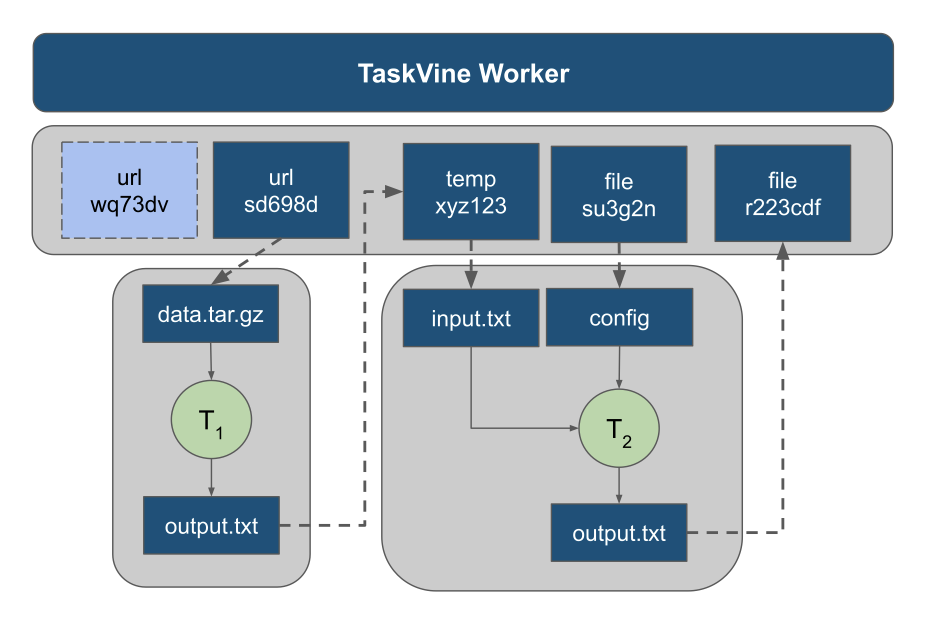
A workflow in TaskVine is expressed in in Python by declaring the data assets needed by the workflow as file objects, and then connecting them to the namespace of each task to execute:

When the tasks execute on each worker, the various data objects are cached on local storage, and then linked into the execution sandbox of each running task.  This provides the opportunity for data to be shared between tasks without moving data to/from the shared filesystem:


This paper gives three examples of applications constructed using TaskVine.  TopEFT is a physics data analysis application built using Coffea+TaskVine, Colmena-XTB is a molecular modeling application built using Parsl+TaskVine, and BGD is a model training application built using TaskVine alone.  Each of these codes is able to scale to 400-1000 nodes running on 1000-27000 cores total.

For all the details, please check out our paper here:


Tuesday, October 3, 2023

CCTools 7.7.0 Released

We are pleased to announce the release of version 7.7. of the Cooperative Computing Tools from the University of Notre Dame, including TaskVine, Work Queue, Makeflow, Parrot, Chirp, and other software.

This is a feature release that primarily improves the scalability and performance of TaskVine:

Main Features:

  • TaskVine workers now perform transfers asynchronously while communicating with manager, by @BarrySlyDelgado
  • TaskVine Serverless function execution simplified and accelerated by @tphung3
  • Improved integration of Parsl and TaskVine by @tphung3
  • Improved scheduler performance in Work Queue and TaskVine by @colinthomas-z80
  • Multiple improvements to reliability at scale with physics applications by @btovar
  • Change to API for cancelling tasks: all tasks are now returned by vine_wait by @dthain
  • Change to serverless resource management: functions consume library resources by @dthain
  • Improved visualization by @JinZhou5042
  • New environment.yml for development dependencies by @thieber22

Full Changelognightly...release/7.7.0

Monday, July 24, 2023

CCTools 7.6.1 Released

We are pleased to announce the release of version 7.6.1
of the Cooperative Computing Tools from the University of Notre Dame,
including TaskVine, Work Queue, Makeflow, Parrot, Chirp, and other software.

Docs:  https://cctools.readthedocs.io/
Download: http://ccl.cse.nd.edu/software/download
Forum: http://ccl.cse.nd.edu/community/forum

This release introduces several bug fixes and minor improvements to the TaskVine workflow executor and Work Queue scheduler.
TaskVine:
- Fix bug in task scheduling that would result in manager hanging. (Colin Thomas)
- Fix bug in execution of Dask task graphs that would lead to a hang. (Ben Tovar)
- Fix bug in deployment of serverless LibraryTask. (Thanh Phung)
- Add option to specify Python package dependencies inline. (Barry Sly-Delgado)
- Add visualization of task graph and documentation. (Douglas Thain)

Work Queue:
- Fix bug in task scheduling that would result in manager hanging. (Colin Thomas)

Friday, July 7, 2023

CCTools 7.6.0 Released

We are pleased to announce the release of version 7.6.0
of the Cooperative Computing Tools from the University of Notre Dame,
including TaskVine, Work Queue, Makeflow, Parrot, Chirp, and other software.

- Docs: https://cctools.readthedocs.io
- Download: http://ccl.cse.nd.edu/software/download
- Forum: http://ccl.cse.nd.edu/community/forum

This release introduces a number of performance, usability, and
documentation improvements to the TaskVine workflow executor.

TaskVine -
- Integration with Parsl workflow system. (Thanh Phung)
- Integration with Dask workflow system (Ben Tovar)
- Optimized scheduling performance with large numbers of workers. (Colin Thomas)
- Enhanced dispatch performance for small tasks. (Colin Thomas)
- vine_submit_workers combined tool for submtting workers.  (Thanh Phung)
- Improved generation of file cache names (Barry Sly-Delgado)
- fetch_file interface to obtain cached files in the cluster.  (Douglas Thain)
- Worker-to-worker authentication for peer transfers.
- Updated documentation.  (All)

Work Queue:
- Enhanced dispatch performance for small tasks. (Colin Thomas)

Makeflow:
- Now supports TaskVine as an execution mode.  (Douglas Thain)

General:
- TCP catalog updates are performed in a background process to reduce latency.

Thanks goes to the contributors for many features, bug fixes, and tests:

Thanh Son Phung
Barry Sly-Delgado
Colin Thomas
Ben Tovar
Douglas Thain

Enjoy!


Friday, April 28, 2023

Intro to TaskVine at GCASR 2023

Prof. Thain gave the afternoon keynote (Data Intensive Computing with TaskVine) at the GCASR Workshop in Chicago on April 24th.  TaskVine is our latest workflow execution system, just released in March 2023.

The key idea of TaskVine is to exploit the local storage already embedded into clusters for use by complex workflows:


To accomplish this, each node runs a general purpose worker process that manages cached data under unique names, and runs each task within a private namespace:


You can write workflows directly to the TaskVine API, declaring files and tasks and connecting them together.  Or, TaskVine can be used as an executor under existing workflow systems:


Learn more and try it out here: http://ccl.cse.nd.edu/software/taskvine


Monday, April 17, 2023

CCTools version 7.5.2 released


The Cooperative Computing Lab is pleased to announce the release of version 7.5.2 of the Cooperative Computing Tools including TaskVine, WorkQueue, Makeflow, Poncho, Chirp, JX, Parrot, and other software.

The software may be downloaded here:
http://ccl.cse.nd.edu/software/download

This is our first release of TaskVine, our new data intensive workflow execution system. TaskVine make extensive use of in-cluster storage to accelerate workflows, so that data "grows like a vine" through the cluster. See our extensive documentation and examples to learn more!

Detailed items in this release:

  • [TaskVine] First official release (Everyone!)
  • [General] Change catalog update to tcp by default (D. Thain)
  • [Work Queue] Specify manager as an argument when using the factory in python (Ben Tovar)
  • [Work Queue] New dynamic resource allocation strategies (Thanh Phung)

Thanks goes to the contributors for many features, bug fixes, and tests:

  • Matthew Carbonaro
  • Jachob Dolak
  • Joseph Duggan
  • Kelci Mohrman
  • Thanh Son Phung
  • David Simonetti
  • Barry Sly-Delgado
  • Douglas Thain
  • Colin Thomas
  • Ben Tovar