Wednesday, August 17, 2022

Demo of the Work Queue executor at Coffea User's meeting

Last August 15, 2022 we gave a demonstration on how to use Coffea using the Work Queue executor. Coffea is a framework for pulling together all the typical needs of a high-energy collider physics (HEP) experiment analysis using the scientific python ecosystem. Using Coffea on top of Work Queue, we can automatically manage the resources (such as cores, memory, and disk) to maximize the number of concurrent tasks that the application can run. Further, since Work Queue tasks can be created dynamically once the application is running, we can shape the size of tasks (in this case, the number of collision of particle events) so that they better fit the resources available.

For this demo, we also showcased a new status display for Work Queue when used inside a jupyter notebook:


Monday, August 1, 2022

iSURE Project: Visualizing and Right Sizing Work Queue Applications

Samuel Huang, an exchange student in the iSURE program, recently completed a summer project with the Cooperative Computing Lab at the University of Notre Dame.  He developed tools for visualizing the performance and behavior of distributed Work Queue applications.  These applications can run on thousands of nodes and may have surprisingly complex behavior over time.  Visualization is key to understanding what's going on.

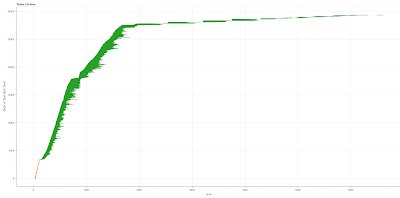
For example, this display shows an application consisting of about 30,000 tasks.  Each line segment shows one task from beginning to end, sorted by submission time.  (The color indicates the type of each task: preprocessing, processing, or accumulation.). As this display clearly shows, this application goes through several distinct phases, in which tasks of different types take increasing amounts of time.  In fact, the last few thousands tasks take much longer, showing a classic "long tail" behavior common to distributed applications.


This display is of the same application, but showing the utilization of the worker processes in the system.  Here you can see delays in provisioning.  The first 60-some workers arrive quite quickly, and the manager is able to dispatch (preprocessing) tasks to them quickly.  The next 200-some workers arrive another minute in, and task some time to be fully utilized, due to the requirements of moving software dependencies for each task.  Finally, at the end of execution, some additional workers become available, but go unutilized due to the change in task resource consumption.


Both these display are now integrated into CCTools in the work_queue_graph_workers tool, which generates a dynamic webpage for digging into the detailed data.

REU Project: TopEFT Performance Analysis: Solving Bottlenecks in Data Transfer and Task Resource Management

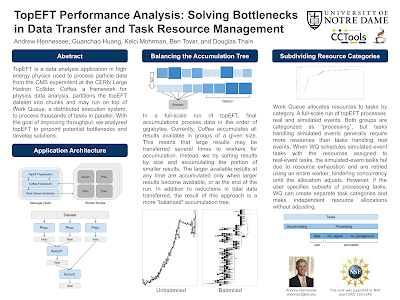
Andrew Hennessy, a junior at Notre Dame, recently completed a summer REU project in which he analyzed and improved the performance of TopEFT, a high energy physics analysis application built using the Coffea framework and the Work Queue distributed execution system.

This applications runs effectively in production, but takes about one hour to complete an analysis on O(1000) cores -- we would like to get it down to fifteen minutes or less in order to enable "near real time" analysis capability.   Andrew built a visualization of the accumulation portion and observed one problem: the data flow is highly unbalanced, resulting in the same data moving around multiple times.  He modified the scheduling of the accumulation step, resulting in a balanced tree with reduced I/O impact.

Next, he observed that processing tasks acting on different datasets have different resource needs: tasks consuming monte carlo (simulated) data take much more time and memory than tasks consuming Production (acquired) data.  This results in a slowdown as the system gradually adjusts to the changing task size.  The solution here is to ask the user to label the datasets appropriately, and place the Monte Carlo and Production tasks in different "categories" in Work Queue, so that resource prediction will be more accurate.

See the entire poster here:


REU Project: Integrating Serverless and Task Computation in Work Queue

David Simonetti, a junior undergraduate at Notre Dame, recently completed a summer REU project in which he added "serverless" computing capabilities to the Work Queue distributed computing framework.

Work Queue has historically used a "task" abstraction in which a complete program with its input files is submitted for remote execution.  David added a capability in which a coprocessor is attached to each worker, providing a hot function execution environment.  Then, lightweight tasks representing single function executions can be sent throughout the distributed system, making use of the existing scheduling, resource management, and data movement capabilities of Work Queue.

This allows for the integrated execution of both conventional whole-process tasks and lightweight functions within the same framework.  Check out the full poster here:


Friday, July 22, 2022

CCTools version 7.4.9 released

 The Cooperative Computing Lab is pleased to announce the release of version 7.4.9 of the Cooperative Computing Tools including Parrot, Chirp, JX, Makeflow, WorkQueue, and other software.

The software may be downloaded here:
http://ccl.cse.nd.edu/software/download

This is a bug fix release:

  • [General] Update binary build to OSX-11. (Ben Tovar)
  • [General] Several updates to JX documentation. (Douglas Thain)
  • [Work Queue] Fix bug where some old files where not deleted from worker's cache. (Ben Tovar)
  • [Work Queue] Fix warning message for required size of workers. (Ben Tovar)
  • [Work Queue] Add transfers size information to transactions log. (Guanchao Huang)


Thanks goes to the contributors for many features, bug fixes, and tests:

  • Andrew Hennessee
  • Guanchao Huang
  • Kelci Mohrman
  • Thanh Son Phung
  • David Simonetti
  • Barry Sly-Delgado
  • Douglas Thain
  • Ben Tovar


Please send any feedback to the CCTools discussion mailing list:

http://ccl.cse.nd.edu/community/forum

Enjoy!