Wednesday, October 1, 2025

eScience 2025: Liberating the Data Aware Scheduler to Achieve Locality in Layered Scientific Workflow Systems

     On September 16 graduate student Colin Thomas presented the paper titled: Liberating the Data Aware Scheduler to Achieve Locality in Layered Scientific Workflow Systems at the 21st IEEE International Conference on eScience in Chicago, Illinois. 


  This work engages mutliple topics including workflow systems, data management, and task scheduling. The title describes two key components; The Data Aware Scheduler, and Layered Scientific Workflow Systems. Data aware schedulers are capable of understanding task data dependencies and making task scheduling decisions based on that information, primarily to benefit from data locality when there is intermediate workflow data which is already cached somewhere in the cluster. It is beneficial to schedule tasks who consume this data to the same site in which the data was created, so that the dependencies to not have to move through the network, or perhaps even out of memory. 

     The term "layered workflow system" is a way to describe multiple popular workflow systems in the HPC community such as Parsl and Dask. These workflow systems consist of two primary components. The DAG manager and executor. The DAG manager understands the workflow composition and data dependencies. The executor receives tasks from the DAG manager and uses its understanding of the cluster and available resources to place tasks on their execution sites. 

     The primary argument of the paper is highlighting the obstacles created by using a data aware scheduler in this layered execution scheme.  If we take a DAG such as the one described by Figure 1, we can easily identify opportunities for data locality in the groups of sequentially dependent tasks. However the data aware scheduler is not privy to this picture of the DAG. Rather the scheduler, or executor, is only aware of tasks which are ready to run, while the DAG manager withholds future task information until they are ready to run as well. This forces a data aware scheduler to make last-minute scheduling decisions based on individual tasks. In many cases it may occupy a node in which a later task would have been better suited due to data locality opportunities. 

     The paper shows an implementation of a modified Parsl DAG manager and TaskVine data aware scheduler which passes through intermediate-dependent sequential tasks to the data aware scheduler before all of them are ready to run. This allows TaskVine to identify the group dependencies and the ideal execution pattern, and schedule these task groups in batches rather than on an individual basis. 

 The result of this increases the data locality achieved on the 2 workflows in the evaluation. In addition it reduces the total number of scheduling operations by a factor of the average task group size. 


The link to the full paper can be found below:

https://ccl.cse.nd.edu/research/papers/liberating-escience-2025.pdf 


Tuesday, September 23, 2025

Floability at eScience 2025: Making Notebooks Portable with Backpacks Across HPC Clusters

Grad student Saiful Islam presented our paper “Backpacks for Notebooks: Enabling Containerized Notebook Workflows in Distributed Environments” at the 2025 IEEE eScience Conference in Chicago, Illinois.

Notebooks have become the de facto interface for scientific computing, but moving from a local notebook to large-scale HPC clusters is far from seamless—especially when the notebook contains a distributed workflow that must be submitted across multiple nodes. A notebook file alone doesn’t capture the full execution context—it misses environment specifications, data locations, and resource requirements. As a result, the same notebook often runs on one system but fails on another.


This paper introduces the concept of a backpack—a lightweight companion that travels with the notebook and captures everything needed for execution. A backpack makes explicit the software environment, data sources, and resource requirements that are often left implicit in code. With Floability, our implementation of backpack specifications, backpacks transform ordinary notebooks into portable, reproducible workflows that can execute across heterogeneous HPC clusters with zero to minimal code modification.

We evaluated Floability on three representative scientific workflows—distributed image convolution, climate trend analysis, and high-energy physics data analysis—running them across five heterogeneous HPC systems (Notre Dame CRC, Purdue Anvil, UT Stampede3, OSPool, and AWS). In each case, backpacks successfully captured the required software and data dependencies, provisioned worker environments, and reproduced execution without code changes. While runtime varied due to site-specific infrastructure like schedulers and storage, all workflows completed consistently, demonstrating that backpacks enable portable, reproducible, and scalable execution of notebook workflows across diverse HPC environments.

For all the details, please check out our paper here: 

Md Saiful Islam, Talha Azaz, Raza Ahmad, A D M Shahadat Hossain, Furqan Baig, Shaowen Wang, Kevin Lannon, Tanu Malik, and Douglas Thain, Backpacks for Notebooks: Enabling Containerized Notebook Workflows in Distributed Environments, IEEE Conference on eScience, pages 9, September 2025.

Project website: https://floability.github.io

Example backpacks: https://github.com/floability/floability-examples

Tuesday, September 16, 2025

Workshop on Harmonizing Python Workflows at IEEE e-Science 2025

We helped host the Workshop on Harmonizing Python Workflows at IEEE International Conference on e-Science on Monday, 15 Sep 2025. 


This workshop is one component of our NSF POSE project to explore the creation of an open source ecosystem encompassing a variety of workflow technologies, including the Parsl Project (Kyle Chard at the University of Chicago), the RADICAL tools (Shantenu Jha, Rutgers University), and TaskVine (Douglas Thain, University of Notre Dame).  

Workshop attendees conducted several working groups where they identified key barriers to workflow creation, deployment, and adoption; proposed activities for an open source ecosystem to support these needs; and provided feedback on the possible structure sof an ecosystem. 

The organizers will be following up soon with a workshop report and draft proposal for next steps. 

Thank you to everyone who participated!


Tuesday, September 9, 2025

Welcome Back, Colin!

This past summer, 4th year PhD student Colin Thomas completed an internship at the National Energy Research Scientific Computing Center (NERSC) located at the Lawrence Berkeley National Laboratory.

Colin worked with a team of researchers and fellow interns to develop and deploy an Inference-as-a-Service (IaaS) platform for particle physics experiments including DUNE and ATLAS. Colin organized a network of services deployed on Kubernetes and the Perlmutter supercomputer which enabled remote scientists to run their applications and perform analysis of their data. The IaaS deployment consisted of metrics collection capabilities used to profile the system, identify bottlenecks, and inform the system about the need to scale the compute resources to meet the demands of users in real-time. The team profiled multiple inference-serving technologies such as Ray Serve and NVIDIA Triton. The team effort resulted in a number of successes including tests with scientists from multiple institutions, the gathering of valuable data from the profiles of Ray and Triton, and the system prototype which can serve as an example for future work in scientific inference serving.

Colin shared with us his wonderful experience during the summer and also gave an engaging talk about the work he has done during our first team meeting. Below is the poster he created and presented. We are excited to learn new ideas and look forward to more inspiring discussions ahead.


Tuesday, September 2, 2025

New Semester, New Faces


The new semester is here, and we’re excited to welcome three new colleagues and roll out a clear plan for the months ahead.

New faces. Lax joins as a first-year Ph.D. student. Ryan just completed his M.S. in our lab and begins his Ph.D. this semester. Abby joins as a first-year M.S. student. We’re glad to have them on board!

Each semester we adjust our routines and schedules to keep the lab running smoothly and to support a diverse team. This semester we’re trying a few new approaches. Colin will organize our weekly team talks with a schedule planned about a month ahead, host practice sessions for conference presentations, and invite remote guests for ~30-minute Zoom talks and discussion. Jin will handle outreach and support: a short blog every Tuesday, cross-posting to LinkedIn and other channels, encouraging GitHub Discussions as a support path, and serving as the first responder for incoming technical questions. Saiful will lead the website migration to a Jekyll site on GitHub, move over most existing content, convert prior posts into native Jekyll, and switch our papers database from PHP + database to a JSON dataset. Ben, the most experienced and supportive engineer who knows every line of the codebase, will guide release engineering: review PRs and give feedback, prioritize and maintain issues, keep integration tests in working order, and plan and ship regular software releases.

This semester, alongside our long-standing systems research, we will explore practical ways to pair our work with LLMs. For example, improving developer documentation, identifying code invariants, visualizing logs, and troubleshooting workflows. Ground rules: you are responsible for your output; do not create extra work for others; use ND-authorized tools such as Gemini and Gemini-CLI to protect data. This week each person will pick a modest task and tool to explore. Next week we will report on methods, results, and observations.

Project highlights.

  • CMS Computing (Barry, Jin, Ben, Alan): keep the current TaskVine release stable and usable; share successes with the HEP community; publish the new cms-taskvine-example repository; advance an IPDPS/TPDS paper on dynamic data reduction.

  • NSF CSSI Floability (Saiful, Abby, Ben): keep the release stable, usable, and documented; attach straightforward data handling for existing applications; grow users and collaborations; build interactive visualization of notebook workflows to support troubleshooting and performance; then extend the approach to new notebook and workflow models.

  • NSF Consistency Contracts (Colin + Jin): complete and release the basic toolchain to measure, summarize, and enforce; choose baseline techniques that exploit application behavior.

  • DOE XGFabric (Ryan, Thanh): capture the full software stack; port to multiple ACCESS sites and troubleshoot issues as they appear; evaluate scale, responsiveness, and resource use; develop solutions for HPC batch queue delays.

  • NSF HARMONY: run a fall workshop on workflow collaboration with the eScience conference; capture examples across Parsl-TaskVine (astro), DaskVine (HEP), and RADICAL (xgfabric).

  • NASA-SADE (Lucas, Lax): demonstrate the simulation infrastructure at the September Year 2 review; evaluate OS scalability and performance; begin integrating native SADE components.

We’ll post a short update every Tuesday and syndicate it to LinkedIn and other channels. Questions and ideas are welcome on GitHub Discussions.


Thursday, May 22, 2025

CCL Team at GCASR 2025


Members of the CCL team traveled to Chicago, Illinois on May 8 to attend GCASR 2025 (12th Greater Chicago Area Systems Research Workshop).
 
CCL team members presented their work in both poster sessions.
 
Barry Sly-Delgado presented: Task Graph Restructuring via Function Based Annotation For Large-Scale Scientific Applications.
 
Colin Thomas presented: Enabling Tailored Optimizations for Scientific Workflows through I/O Tracing.
 
Md. Saiful Islam presented: Floability: Enabling Portable Scientific Workflows Across HPC Facilities.
 
Jin Zhou presented: Effectively Exploiting Node-Local Storage For Data-Intensive Scientific Workflows.


Tuesday, January 14, 2025

Reshaping High Energy Physics Applications Using TaskVine @ SC24

    Barry Sly-Delgado presented our paper titled: "Reshaping High Energy Physics Applications for Near-Interactive Execution Using TaskVine" at the 2024 Supercomputing Conference in Atlanta, Georgia. This paper investigates the necessary steps to convert long-running high-throughput high energy physics applications to high concurrency. This included incorporating new functionality within TaskVine.  The paper presents the speedup gained as changes were incorporated to the workflow execution stack for application DV3. We eventually achieve a speedup of 13X. 


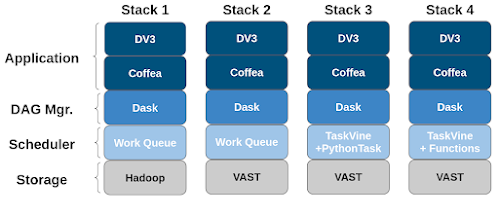
Configurations for each workflow execution stack as improvements were made.

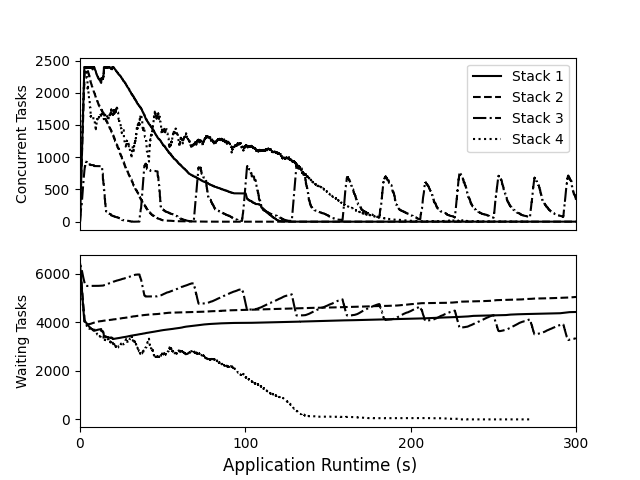
Starting with stack 1. The first change incorporated was to the storage system where initial data sets are stored. This change showed little improvement, taking 3545s runtime to 3378s. This change is minimal as much of the data handling during application execution is related to intermediate results. Initially, with stack 1 and 2, intermediate data movement  is handled via a centralized manager. 


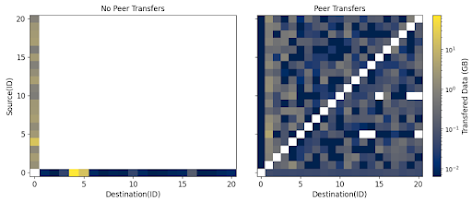
data movement during application execution between Work Queue and TaskVine. With TaskVine, the most data exchanged between any two nodes tops off around 4GB (the manger is node 0). With Work Queue the most data transferred is 40GB

Incorporated in stack 3 is a change of scheduler, TaskVine. Here, TaskVine allows for intermediate results to be stored on node-local storage and transferred between peer compute nodes. This relieves strain on the centralized manager and allows it to schedule tasks more effectively. This change drops the runtime to 730s.


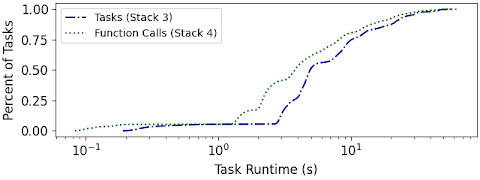
CDF of task runtimes within the application per execution paradigm. With Function Calls, individual tasks execute faster.

Our final improvement changes the previous task execution paradigm within TaskVine. Initially "PythonTasks" serialized functions along with arguments and distributed them to compute nodes to execute individual tasks. Under this paradigm, the python interpreter would be invoked for each individual task. Our new task execution paradigm, "Function Calls" stands up a persistent Python process, "Library Task", that contains function definitions that can be invoked via individual function calls. Thus, invocations of the Python interpreter are reduced from per-task to per-compute-node. This change reduces runtime to 272s for a 13X speedup from our initial configuration.

Application execution comparison between stack configurations.

Tuesday, January 7, 2025

Shepherd Paper at WORKS/SC 2024

Grad student Saiful Islam presented our paper on Shepherd at the 19th Workshop on Workflows in Support of Large-Scale Science at Supercomputing 2024 in Atlanta, Georgia.

Shepherd is a local workflow manager that enables a fleet of actions and services to functionally behave as a single task. This allows us to seamlessly deploy these local workflows into HPC clusters at large scale. For example, consider a workflow for large-scale distributed drone simulation. This workflow includes steps such as preprocessing, creating a configuration, running simulations, and post-processing. We aim to deploy the "run simulation" step in HPC clusters at large scale. However, each "run simulation" step includes a local workflow that needs to perform specific actions and start services like Gazebo, PX4, and Pose Sender. These services and actions depend on each other’s internal states. For example, when Gazebo reaches the "ready" state, the nth PX4 service is started. Without Shepherd, the workflow becomes as shown in the following figure:


With Shepherd, the entire "run simulation" step becomes a single task of running Shepherd with a specified configuration. Shepherd starts the required actions and services, manages dependencies, and ensures the graceful shutdown of services when they are no longer needed. This enables complex workflows of actions and services to be seamlessly integrated with a larger distributed workflow manager, as shown in the following figure:


The paper discusses the architecture and design principles of Shepherd, showcasing its application to large-scale drone simulations and integration testing.

Shepherd uses a YAML-based workflow description to define tasks, dependencies, and execution conditions. It monitors logs and file generation to infer internal states and manage lifecycles effectively. Additionally, it generates three visualizations post-execution for debugging and documentation. For instance, the figure below illustrates a timeline of a 100-drone simulation distributed across 25 nodes, with each Shepherd instance managing 4 drones. A zoomed-in view highlights how components execute at varying times across nodes, which becomes challenging without awareness of service readiness. Shepherd simplifies this with YAML-based configurations and internal state tracking.


For all the details, please check out our paper here:


Monday, December 9, 2024

Data Pruning Mechanism in Daskvine

In our recent work, we introduced a file pruning technique into DaskVine to address challenges in managing intermediate files in DAG-based task graphs. This technique systematically identifies and removes intermediate stale files—those no longer needed by downstream tasks—directly from worker nodes. By freeing up storage in real time, file pruning not only enables workers to process more computational tasks with limited disk space but also makes applications feasible that were previously constrained by storage limitations.

Specifically, the pruning algorithm monitors task execution in the graph, categorizing tasks as waiting or completed. Once a task finishes, it prunes its parent tasks’ output files if all dependent child tasks are done and immediately submits dependent tasks for execution when their inputs are ready.

To evaluate the effectiveness of our file pruning technique, we utilized four key metrics:

File Retention Rate (FRR): FRR represents the ratio of a file's retention time on storage to the total workflow execution time. It indicates how long files remain in storage relative to the workflow's progress. A shorter FRR reflects more efficient pruning. The following figures show the FRR over all intermediate files, each producing by one specific task. The left graph (FCFS) shows higher and more uniform FRR, where files remain on storage for a significant portion of the workflow. In contrast, the right graph (FCFS with Pruning) shows a clear reduction in FRR for most files, which proves that pruning reduces storage usage by removing stale files promptly.


Accumulated Storage Consumption (ASC) and Accumulated File Count (AFC)ASC measures the total amount of storage consumed across all worker nodes throughout the workflow execution, while AFC tracks the total number of files retained across all worker nodes during the workflow. In the following, the left graph shows that both ASC and AFC steadily increase throughout the workflow, peaking at 1082.94 GB and 299,787 files, respectively. This highlights significant storage pressure without pruning. The right graph demonstrates dramatic reductions, with peaks at 326.78 GB for ASC and 80,239 files for AFC. This confirms that pruning effectively reduces storage consumption and file count by promptly removing unnecessary intermediate files.

Worker Storage Consumption (WSC): WSC reflects the storage consumption of individual workers at any point during the workflow execution. It helps assess the balance of storage usage among workers. The left graph shows a peak WSC of 24.95 GB, indicating high storage pressure on individual workers. In contrast, the right graph shows a significantly lower peak of 7.07 GB, demonstrating that pruning effectively reduces storage usage per worker and balances the load across the cluster.


Sunday, December 1, 2024

TaskVine + Parsl Integration

 The Cooperative Computing Lab team has an ongoing collaboration with the Parsl Project, maintaining the TaskVine Executor for use with the Parsl workflow system. Using the TaskVine executor involves expressing an application using the Parsl API, where tasks are created and managed using the Parsl Data Flow Kernel. Tasks are passed to the executor which makes final scheduling decisions. 

The TaskVine executor offers a number of features involving data management and locality scheduling. The distinction between the TaskVine executor and other available executors is largely the awareness of data dependencies and the use of node-local storage. There are a number of features to the TaskVine executor that have been recently added or are in progress. 

One prominent new feature is the extension of TaskVine function invocations to the TaskVine executor. Function invocations reduce the overhead of starting new tasks, considerably benefiting workflows with many short-running tasks. TaskVine function calls have been described with greater detail in this article by Thanh Son Phung. This benefit to task startup latency is especially useful for the Parsl/TaskVine executor, since Parsl is a python-native application. Normally each task must consider starting a new python process and loading all modules used by Parsl as well as the user's application. With short running tasks, such as ones resembling quick function calls, the overhead of loading this information from shared storage, or transferring it to local storage and starting a new python process can be greater than the running time of the task itself. TaskVine function invocations allow this runtime environment information to be effectively cached, and multiple tasks to run sequentially in the same python process. A molecular dynamics application using the Parsl/TaskVine executor is shown below, with L1 being simple tasks, and L2 using TaskVine function invocations.


Other new changes to the TaskVine executor include the addition of the tune_parameters to the executor configuration. TaskVine is highly configurable by users to suit the needs of their particular application or cluster resources. Adding this option to the TaskVine executor allows users to automatically replicate intermediate data, configure the degree of replication desired, disable peer transfers, and several in-depth scheduling options which fit different specific task dispatch and retrieval patterns.